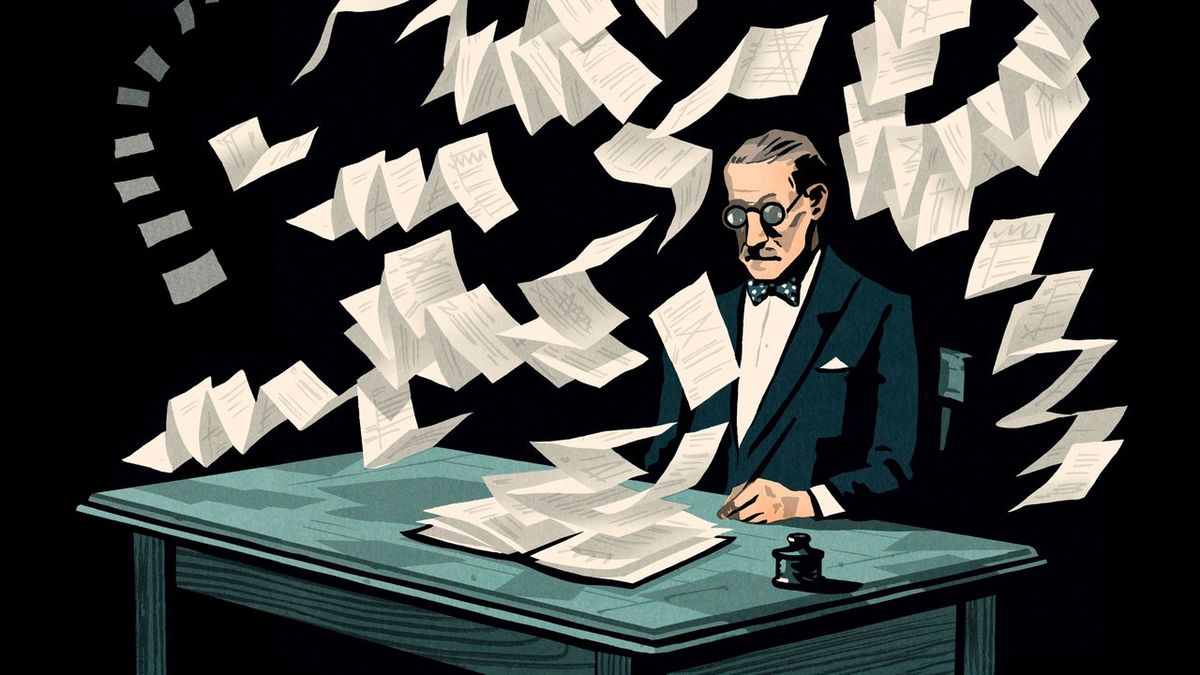
It is not like reading a story that one reads James Joyce’s Ulysses. Plot becomes less obsessive, time is also subject to bending, and even language itself is insecure. The experience I get is thought in motion, fragmented, recursive, intrusive, intimate. Joyce does not invite us to see characters on the outside; he compels us to live in their minds. By doing so, Ulysses fundamentally re-invents the functioning of time in fiction and reveals a contemporary crisis: how to lead a meaningful life in a world in which time ceases to be perceived to be linear, coherent and sacred.
Fundamentally, Ulysses turns a normal day into an epic not by making things bigger, but by making them perceived bigger. The effect is a novel in which minutes will be pages, memories will come between the present and the past, and inner life will be a physical action as much as the rest.
Stream of Consciousness: Thought as Reality
The most radical technique used by Joyce is the stream of consciousness one- this mode of narration that follows the stream of ideas as they come. We are not exposed to well-constructed sentences and logical flow, but rather to sensations, half-formed ideas, flashbacks and language games. This style is initially disorienting, but it is also something that is all too familiar: the actual working of the mind.
Reading, I discover that thought does not follow grammar or chronology. One idea sparks another. The past breaks in unannounced. Privacy associations are provoked by external stimuli. Joyce does not consider this mental activity as a background noise, but the primary event. The setting is the consciousness itself.
This strategy destroys the conventional fiction pecking order. Action is no longer primarily a matter of meaning, inner experience is. A character simply strolling along the street may have as much narrative load as a battle scene, since that is where the real drama takes place.
A Single Day, Infinitely Expanded
Ulysses is set especially in a single day in Dublin. But that day seems huge, stratified, and insecure. Joyce slows down the time, stretching it by using it as a memory, fantasy, and reflection. Years of experience can be condensed in a few seconds of contemplation.
The details that I find most remarkable are the fact that the present is never separate. Each scene is filled with the past. The memory leaks into the perception and the distinction between the present and the past is blurred. Ulysses time is not a linear time, it is a net.
This is an expression of a contemporary feeling of temporal dislocation. The characters are not moving with confidence into the future; they are going round with memory, habit and repetition. Joyce is able to portray a world where time ceases to bring improvement, just adding on.
The Crisis of Time in the Modern World
The beginning of the twentieth century was a time of revolution- technological shift, political instability, and the undermining of conventional values. Ulysses is unstable and this can be seen in the broken sense of time. Experience is no longer organized around the old certainties -religion, nationalism, linear history.
Rather, time is made subjective. It is lengthened by boredom, falls by feeling, disintegrates by memory. Throughout the novel, it is my impression that time is no longer something that characters live in comfortably. It crushes, pursues them, overpowers them.
This is particularly evident in the treatment of routine in the novel. Rituals of daily life, eating, walking, working, etc., are repeated in the same manner, but they never seem to ground. Practicing something does not make it stable; it makes it stagnant. Modern life is also temporally overloaded as Joyce shows it as one that the mind is never present since it is always elsewhere.
Leopold Bloom and the Weight of Everyday Time
Leopold Bloom is an expression of this crisis of time. He wanders around the city at work, but his thoughts are always wandering, whether it is memories of loss, fantasies, anxieties, and observations. He is not driven on by time; time pressures him.
The consciousness of Bloom is porous. He subjects himself to the details of the world and takes them along, giving sense to mundane events. This is what renders his experience very human and mute heroic. It is not a conquest of space, but a conquest of time that makes Bloom follow the path of a novel resembling the epic of Homer.
What impresses me the most is that Bloom manages to survive not by using any great action, but by noticing and empathizing. His ability to observe, think, and nurture, in a discontinued time world, is his resistance.
Language as Temporal Experiment
It is not only that Joyce distorts time by structure that he does it by language. The style of each episode is different, it replicates the development of English prose, parodies various genres or strands the limits of language. This instability of time in the novel is reflected in this stylistic restlessness.
Language acts as a time machine. It is full of historical echo, cultural memory and personal associations simultaneously. When reading, I always remember that nothing can be definite in meaning. Words build stratification as consciousness does.
Rejecting one voice of narration, one style, Joyce rejects the notion of the possibility of an ordered time, an ordered truth. This makes the novel a document of plurality of time, in which a great number of pasts exist in the present.
Molly Bloom and Time Without Punctuation
The last part of the novel is an extremation of stream of consciousness. Time is virtually obliterated as the flow of thought is not marked by a full stop or a check. The memory, the desire, and sensation are amalgamated into an unending present.
This part is eternal--not that time ceases, but that it has been disorganized. The past is re-experienced, the future envisioned and the present expanded into a wide interior space. According to Joyce, time when passed through consciousness becomes emotive as opposed to chronological.
Here time crisis is strangely resolved. Rather than fragmentation, there is continuity but not logical but lived. Time is experienced and not quantified.
Conclusion: Consciousness as the New Epic
Ulysses substitutes heroic action with the mental stamina and substitutes linear time with the subjective experience. By means of stream of consciousness, Joyce discloses that the contemporary life is not characterized by the events, but rather by how they are consumed.
The thing that lingers in my mind is the fact that time in Ulysses is repressive as well as free. It captures personalities in mind and habit, but it also permits space to stretch, grow, and reverberate. In returning to himself, Joyce discovers a new form of epic one that celebrates the richness of consciousness and that faces an world in which time has ceased to follow reassuring, easy, and straightforward paths.
In the end, Ulysses suggests that meaning does not come from escaping time, but from fully inhabiting it, thought by thought, moment by moment.